RandomNoise
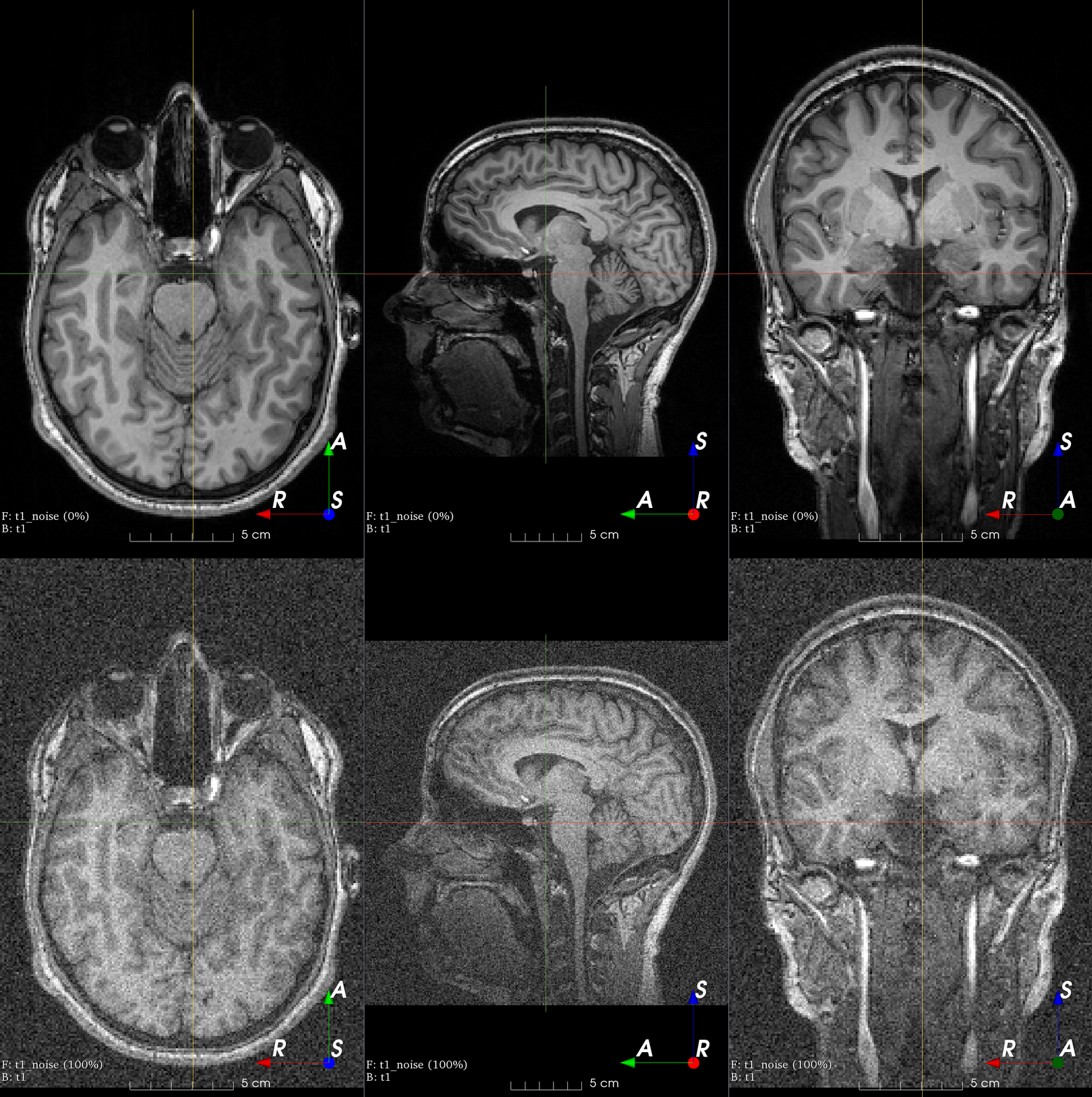
RandomNoise
Bases: RandomTransform, IntensityTransform
Add Gaussian noise with random parameters.
Add noise sampled from a normal distribution with random parameters.
Parameters:
| Name | Type | Description | Default |
|---|---|---|---|
mean
|
float | tuple[float, float]
|
Mean \(\mu\) of the Gaussian distribution from which the noise is sampled. If two values \((a, b)\) are provided, then \(\mu \sim \mathcal{U}(a, b)\). If only one value \(d\) is provided, \(\mu \sim \mathcal{U}(-d, d)\). |
0
|
std
|
float | tuple[float, float]
|
Standard deviation \(\sigma\) of the Gaussian distribution from which the noise is sampled. If two values \((a, b)\) are provided, then \(\sigma \sim \mathcal{U}(a, b)\). If only one value \(d\) is provided, \(\sigma \sim \mathcal{U}(0, d)\). |
(0, 0.25)
|
**kwargs
|
See |
{}
|
__call__(data)
Transform data and return a result of the same type.
Parameters:
| Name | Type | Description | Default |
|---|---|---|---|
data
|
InputType
|
Instance of |
required |
get_base_args()
Provides easy access to the arguments used to instantiate the base class
(Transform) of any transform.
This method is particularly useful when a new transform can be represented as a variant
of an existing transform (e.g. all random transforms), allowing for seamless instantiation
of the existing transform with the same arguments as the new transform during apply_transform.
Note
The p argument (probability of applying the transform) is excluded to avoid
multiplying the probability of both existing and new transform.
add_base_args(arguments, overwrite_on_existing=False)
Add the init args to existing arguments
validate_keys_sequence(keys, name)
staticmethod
Ensure that the input is not a string but a sequence of strings.
to_hydra_config()
Return a dictionary representation of the transform for Hydra instantiation.
arguments_are_dict()
Check if main arguments are dict.
Return True if the type of all attributes specified in the
args_names have dict type.