HistogramStandardization
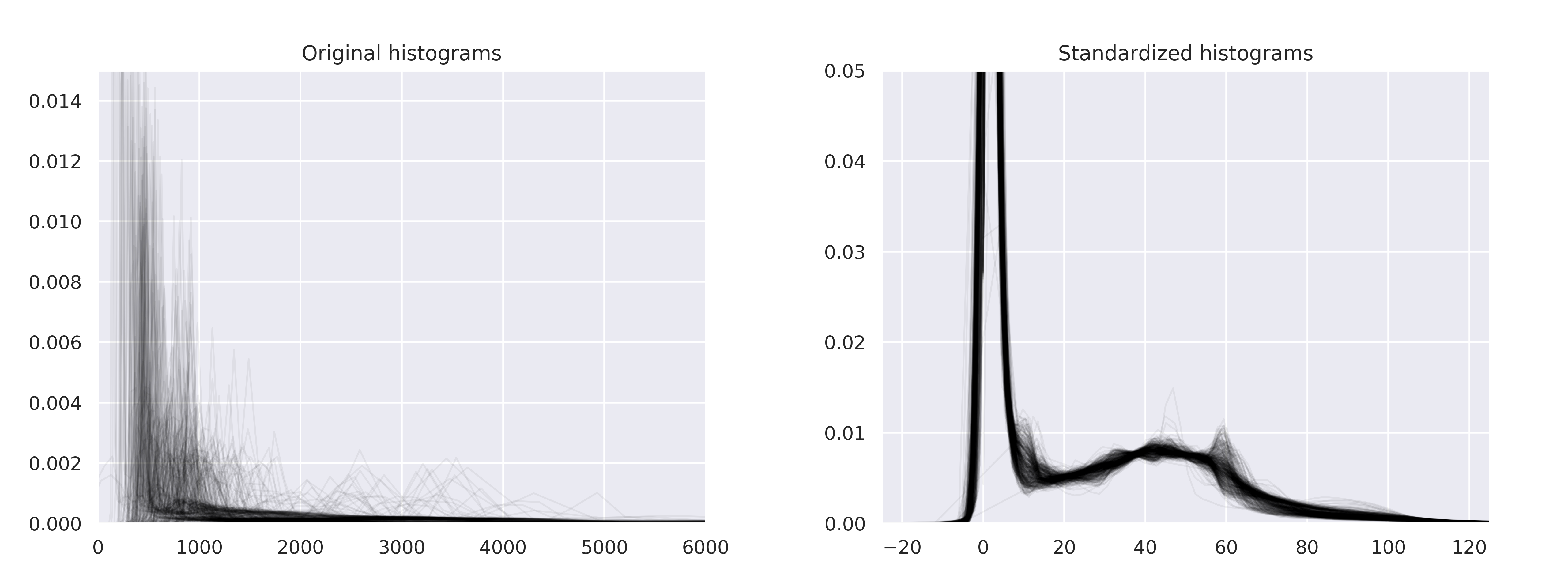
HistogramStandardization
Bases: NormalizationTransform
Perform histogram standardization of intensity values.
Implementation of New variants of a method of MRI scale standardization .
See example in torchio.transforms.HistogramStandardization.train().
Parameters:
| Name | Type | Description | Default |
|---|---|---|---|
landmarks
|
TypeLandmarks
|
Dictionary (or path to a PyTorch file with |
required |
masking_method
|
TypeMaskingMethod
|
None
|
|
**kwargs
|
See |
{}
|
Examples:
>>> import torch
>>> import torchio as tio
>>> landmarks = {
...     't1': 't1_landmarks.npy',
...     't2': 't2_landmarks.npy',
... }
>>> transform = tio.HistogramStandardization(landmarks)
>>> torch.save(landmarks, 'path_to_landmarks.pth')
>>> transform = tio.HistogramStandardization('path_to_landmarks.pth')
probability = self.parse_probability(p)
instance-attribute
copy = copy
instance-attribute
keep = keep
instance-attribute
parse_input = parse_input
instance-attribute
label_keys = label_keys
instance-attribute
name
property
masking_method = masking_method
instance-attribute
landmarks = landmarks
instance-attribute
landmarks_dict = self._parse_landmarks(landmarks)
instance-attribute
args_names = ['landmarks', 'masking_method']
instance-attribute
__call__(data)
Transform data and return a result of the same type.
Parameters:
| Name | Type | Description | Default |
|---|---|---|---|
data
|
InputType
|
Instance of |
required |
__repr__()
get_base_args()
Provides easy access to the arguments used to instantiate the base class
(Transform) of any transform.
This method is particularly useful when a new transform can be represented as a variant
of an existing transform (e.g. all random transforms), allowing for seamless instantiation
of the existing transform with the same arguments as the new transform during apply_transform.
Note
The p argument (probability of applying the transform) is excluded to avoid
multiplying the probability of both existing and new transform.
add_base_args(arguments, overwrite_on_existing=False)
Add the init args to existing arguments
apply_transform(subject)
add_transform_to_subject_history(subject)
to_range(n, around)
staticmethod
parse_params(params, around, name, make_ranges=True, **kwargs)
_parse_range(nums_range, name, min_constraint=None, max_constraint=None, type_constraint=None)
staticmethod
Adapted from [torchvision.transforms.RandomRotation][].
Parameters:
| Name | Type | Description | Default |
|---|---|---|---|
nums_range
|
TypeNumber | tuple[TypeNumber, TypeNumber]
|
Tuple of two numbers \((n_{min}, n_{max})\), where \(n_{min} \leq n_{max}\). If a single positive number \(n\) is provided, \(n_{min} = -n\) and \(n_{max} = n\). |
required |
name
|
str
|
Name of the parameter, so that an informative error message can be printed. |
required |
min_constraint
|
TypeNumber | None
|
Minimal value that \(n_{min}\) can take, default is None, i.e. there is no minimal value. |
None
|
max_constraint
|
TypeNumber | None
|
Maximal value that \(n_{max}\) can take, default is None, i.e. there is no maximal value. |
None
|
type_constraint
|
type | None
|
Precise type that \(n_{max}\) and \(n_{min}\) must take. |
None
|
Returns:
| Type | Description |
|---|---|
tuple[TypeNumber, TypeNumber]
|
A tuple of two numbers \((n_{min}, n_{max})\). |
Raises:
| Type | Description |
|---|---|
ValueError
|
if |
ValueError
|
if \(n_{max}\) or \(n_{min}\) is not a number |
ValueError
|
if \(n_{max} \lt n_{min}\) |
ValueError
|
if |
ValueError
|
if |
ValueError
|
if |
parse_interpolation(interpolation)
staticmethod
parse_probability(probability)
staticmethod
parse_include_and_exclude_keys(include, exclude, label_keys)
staticmethod
validate_keys_sequence(keys, name)
staticmethod
Ensure that the input is not a string but a sequence of strings.
nib_to_sitk(data, affine)
staticmethod
sitk_to_nib(image)
staticmethod
_get_reproducing_arguments()
Return a dictionary with the arguments that would be necessary to reproduce the transform exactly.
is_invertible()
inverse()
_use_seed(seed)
staticmethod
Perform an operation using a specific seed for the PyTorch RNG.
get_sitk_interpolator(interpolation)
staticmethod
parse_bounds(bounds_parameters)
staticmethod
ones(tensor)
staticmethod
mean(tensor)
staticmethod
get_mask_from_masking_method(masking_method, subject, tensor, labels=None)
get_mask_from_anatomical_label(anatomical_label, tensor)
staticmethod
get_mask_from_bounds(bounds_parameters, tensor)
_get_name_with_module()
Return the name of the transform including its module.
_tuples_to_lists(obj)
staticmethod
to_hydra_config()
Return a dictionary representation of the transform for Hydra instantiation.
get_images_dict(subject)
get_images(subject)
arguments_are_dict()
Check if main arguments are dict.
Return True if the type of all attributes specified in the
args_names have dict type.
__init__(landmarks, masking_method=None, **kwargs)
_parse_landmarks(landmarks)
staticmethod
apply_normalization(subject, image_name, mask)
train(images_paths, cutoff=None, mask_path=None, masking_function=None, output_path=None, *, progress=True)
classmethod
Extract average histogram landmarks from images used for training.
Parameters:
| Name | Type | Description | Default |
|---|---|---|---|
images_paths
|
Sequence[TypePath]
|
List of image paths used to train. |
required |
cutoff
|
tuple[float, float] | None
|
Optional minimum and maximum quantile values, respectively, that are used to select a range of intensity of interest. Equivalent to \(pc_1\) and \(pc_2\) in Nyúl and Udupa's paper . |
None
|
mask_path
|
Sequence[TypePath] | TypePath | None
|
Path (or list of paths) to a binary image that will be
used to select the voxels use to compute the stats during
histogram training. If |
None
|
masking_function
|
Callable | None
|
Function used to extract voxels used for histogram training. |
None
|
output_path
|
TypePath | None
|
Optional file path with extension |
None
|
Examples:
>>> import torch
>>> import numpy as np
>>> from pathlib import Path
>>> from torchio.transforms import HistogramStandardization
>>>
>>> t1_paths = ['subject_a_t1.nii', 'subject_b_t1.nii.gz']
>>> t2_paths = ['subject_a_t2.nii', 'subject_b_t2.nii.gz']
>>>
>>> t1_landmarks_path = Path('t1_landmarks.npy')
>>> t2_landmarks_path = Path('t2_landmarks.npy')
>>>
>>> t1_landmarks = (
...     t1_landmarks_path
...     if t1_landmarks_path.is_file()
...     else HistogramStandardization.train(t1_paths)
... )
>>> np.save(t1_landmarks_path, t1_landmarks)
>>>
>>> t2_landmarks = (
...     t2_landmarks_path
...     if t2_landmarks_path.is_file()
...     else HistogramStandardization.train(t2_paths)
... )
>>> np.save(t2_landmarks_path, t2_landmarks)
>>>
>>> landmarks_dict = {
...     't1': t1_landmarks,
...     't2': t2_landmarks,
... }
>>>
>>> transform = HistogramStandardization(landmarks_dict)