RemoveLabels
RemoveLabels
Bases: RemapLabels
Remove labels from a label map.
The removed labels are remapped to the background label.
This transformation is not invertible .
Parameters:
| Name | Type | Description | Default |
|---|---|---|---|
labels
|
Sequence[int]
|
A sequence of label integers that will be removed. |
required |
background_label
|
int
|
integer that specifies which label is considered to
be background (typically, |
0
|
masking_method
|
TypeMaskingMethod
|
See |
None
|
**kwargs
|
See |
{}
|
__call__(data)
Transform data and return a result of the same type.
Parameters:
| Name | Type | Description | Default |
|---|---|---|---|
data
|
InputType
|
Instance of |
required |
get_base_args()
Provides easy access to the arguments used to instantiate the base class
(Transform) of any transform.
This method is particularly useful when a new transform can be represented as a variant
of an existing transform (e.g. all random transforms), allowing for seamless instantiation
of the existing transform with the same arguments as the new transform during apply_transform.
Note
The p argument (probability of applying the transform) is excluded to avoid
multiplying the probability of both existing and new transform.
add_base_args(arguments, overwrite_on_existing=False)
Add the init args to existing arguments
validate_keys_sequence(keys, name)
staticmethod
Ensure that the input is not a string but a sequence of strings.
to_hydra_config()
Return a dictionary representation of the transform for Hydra instantiation.
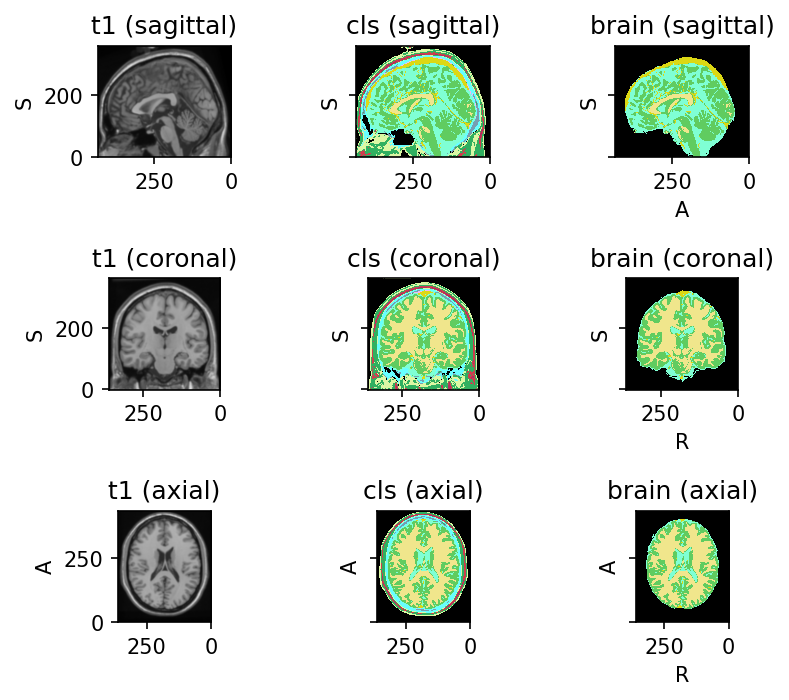
Source code
import torchio as tio
colin = tio.datasets.Colin27(2008)
label_map = colin.cls
colin.remove_image('t2')
colin.remove_image('pd')
names_to_remove = (
    'Fat',
    'Muscles',
    'Skin and Muscles',
    'Skull',
    'Fat 2',
    'Dura',
    'Marrow'
)
labels = [colin.NAME_TO_LABEL[name] for name in names_to_remove]
skull_stripping = tio.RemoveLabels(labels)
only_brain = skull_stripping(label_map)
colin.add_image(only_brain, 'brain')
colors = {
    0: (0, 0, 0),
    1: (127, 255, 212),
    2: (96, 204, 96),
    3: (240, 230, 140),
    4: (176, 48, 96),
    5: (48, 176, 96),
    6: (220, 247, 164),
    7: (103, 255, 255),
    9: (205, 62, 78),
    10: (238, 186, 243),
    11: (119, 159, 176),
    12: (220, 216, 20),
}
colin.plot(cmap_dict={'cls': colors, 'brain': colors})